Taos The Paseo: 40th Annual Taos Fall Arts Festival

taos the paseo

The Paseo is a festival dedicated to bringing the art of installation, performance and projection to the streets of Taos, New Mexico.

Occurring in collaboration with Taos Fall Arts Festival, The Paseo unites the 2014 fall arts venues, creating a new platform for the public display of art within the Taos Historic District.

Core Ethos
Creating a platform for art that is: experimental, time-based, ephemeral, participatory, and context responsive
Encouraging a conversation on contemporary art practices; local and global
Engaging the local community through education, workshops, and presentations
Challenging art and audience: local and global
Supporting local artists and businesses; emergent and established
Respecting art making

AHA Festival

Visual Arts

Septemeber 13-14 2014 | Santa Fe Railyard

visual arts


The programming listed below takes place on Sunday, September 14 from 1:00 pm – 9:00 pm in the Railyard. Free.

Rebecca Alvarez will create Reminiscence, a collection of letterpress posters, each inspired by a person and displayed with a letter she has written to that person anonymously.

Axle Contemporary will present Economologies, a series that aims to “encourage a conversation around the intersections of economics, ecology and art, including critical commentary and new approaches and alternatives to the status quo.”

Seiya Bowen will show Vending Machines, a series of photographs in which he documents the “highly advanced vending machines” found in and around small villages in rural Japan.

Flamingo Pink! will present Art What You Hear(t), an interactive space in which audience members are encouraged to draw on booth walls in response to the music being performed by the artist.

Sydney Cooper will present Japanese Jewish Market, “a commentary on art and identity in Santa Fe” in which the artist presents and discusses objects made by herself, an authentic Japanese Jew.

Sofie Cruse will create a hanging implement of test tubes and flowers, each possessing its own unique color and smell and working together to filter and reflect sunlight.

Brittny Dayes will create The Curious Tumbleweed, “an installation of hand picked and hand painted New Mexican tumbleweeds.”

Aline Hunziker will display Lost and Found, a collection of works created by embroidering English and Spanish text onto pieces garbage to reflect her “mixed feelings about living in our post-industrial society, with all of its benefits and waste.”

INSIDE OUT will create a sneak preview of their October 11 exhibit at James Kelly Contemporary, which features work by Santa Fe artists who are receiving support for mental illness issues.

Erica Kramer and Katy Gross will create SEARING, pairing audio recordings with photographs to create “microenvironments of sound and image” that invoke a sense of the unique time and place that is contemporary Santa Fe.

Phat Le will create Silk, a video projection on fabric sculpture that represents the conflict inherent in the artist’s experience of US culture compared to the culture of his native Vietnam.

Shelbie Loomis will hang her works on paper and invite festivalgoers to engage in live portaiture as both artist and subject

New Mexico School for The Arts students will create an interactive installation

Jim Ricks (Dublin) will set up an photo studio that prints in ASCII, a vintage graphic design technique that uses the 95 printable characters of a computer to create images.

Christian Ristow (Taos) will install The Fledgling, a giant mechanical bird whose 43-foot wings are pedal-powered by festival-going humans. This project made possibly by the New Mexico Art in Public Places program.

Selavy Projects will create Beauty Mark, a jewelry store complete with display cases, mirrors, and a salesperson “that presents art and images of jewelry instead of actual jewelry” featuring work by Zoe Blackwell, Lara Nickel, Joanne Lefrak and Autry Tolbert.

Carl Smith (Berlin) will show Body Clock, Rewound, a group of paintings developed by combining images of contemporary dancers with images of watch parts.

Brandon Soder will show two years’ worth of portraits from The Yearbook Project at AHA Festivals past as well as sell limited edition copies of the yearbook itself.

The Soft Museum will create an interactive space for vending and trading their streetwear, boutique jewelry and art toys that combine their “kawaii, desert punk, and glamour aesthetic.”

Squirrel Mart will create SqArt-O-Mat Mega, a giant vending machine through which they “will craft objects, experiences and deep thoughts suitable for exchange with ‘customers’ via a series of levers, wires, mirrors, gears and projectiles.”

Todd Ryan White will show new work including affordable, limited-edition screen prints and a series of burned drawings created by using a soldering iron on paper.

Vanessa Wilde & Diego Alonso-Garcia will showcase their four-color process fine art prints and receive creative suggestions from the audience for live screenprinting of one-of-a-kind prints.

E.M. Wingren will create Twin, an interactive sound- and light-based installation that responds to the viewer’s movements, “with user-bodies and the space within the installation working together to create a space-instrument.”

Eric Todd and Roberto Perez (Houston) will create a 300-square foot interactive digital environment that will give the viewer “a chance to create his or her own distinct aesthetic experience.” This project made possible by the New Mexico Art in Public Places program.

Christopher Johnson will create an interactive poetry project in which audience members will be asked to contribute to an evolving poem whose lines are seeded by local poets including Dana Levin, Lauren Camp, Elizabeth Jacobson, Jon Davis, and Michael J. Wilson.

Local IQ: That’s Where You Need to Be

Local IQ Albuquerque Original Article: Local IQ Albuquerque: That’s Where You Need to Be

By Mateo Coffman  Tuesday, 22 July 2014

richard levy gallery richardson
That’s Where You Need to Be 16, oil on canvas

That’s Where You Need to Be showcases the perceptions of four artists, each using their craft to challenge conventional standards. William Betts uses software and a robotic setup to re-create photographs one drop of color at a time.

The result is a blurry, low-res image that is indecipherable up close, but from a distance his subject becomes clear — a technique Betts employs to manipulate the connections between painter, viewer and image.

Maria Park wants to examine how technology changes the way we look at the world. Using large walls and plexiglass cubes of her own devising, Parks adds thick layers of color to paint blocky suburban landscapes and scenic environments, challenging our everyday perception of beauty.

Using light and reflection, Xuan Chen conceives simple forms on her computer and then deconstructs her images in a way that exaggerates their irregularities.

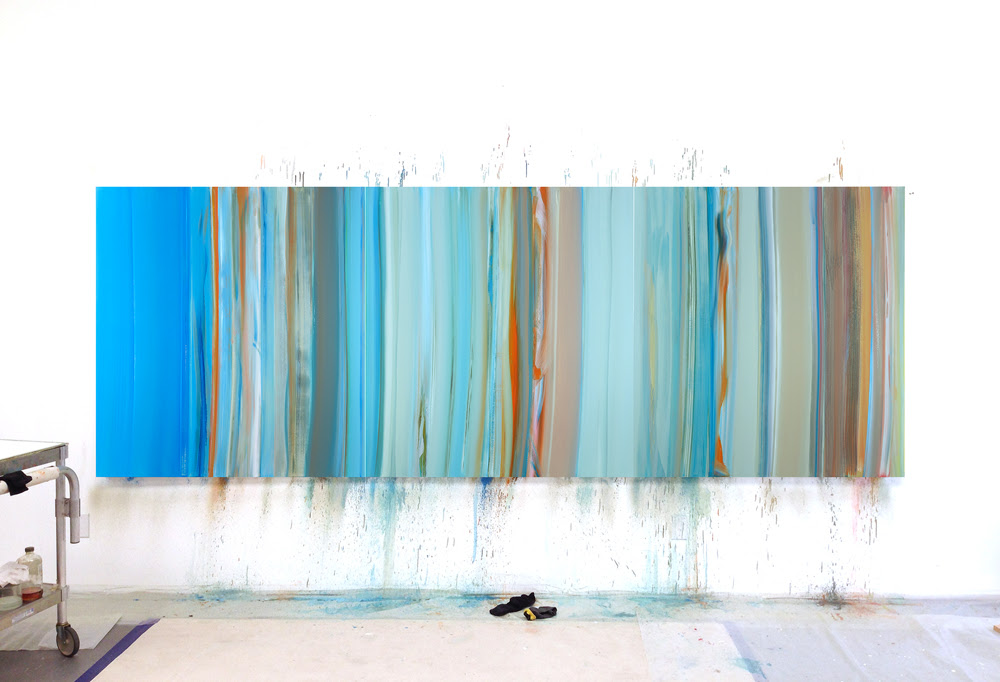
Lastly, Willy Bo Richardson wants his viewers to consider the laws of nature while looking at his pieces. He uses an array of vertical streaks in expressive colors, each in its rightful space. His pieces are often large, colorful and abstract, embodying space and action and with a unique atmosphere all their own.

download PDF: Local IQ Albuquerque Aug 2014

Lama Ole Nydahl

There are both positive and negative opinions about him online. When I searched for further information about his centre, I may have identified the reason. Through his hard work, he has developed a huge organisation consisting of over 600 centres, mainly throughout Europe. It is a massive organisation with thousands of members and naturally such a successful organisation will invite detractors as well.

List of websites with positive feedback:
https://www.tsemrinpoche.com/tsem-tulku-rinpoche/great-lamas-masters/lama-ole-nydahl.html

https://en.wikipedia.org/wiki/Ole_Nydahl


https://www.scmp.com/magazines/post-magazine/long-reads/article/2087405/lama-ole-nydahl-talks-drugs-meditation-and-losing


Richard Levy Gallery – That’s Where You Need to Be

Richard Levy Gallery
That’s Where You Need to Be
August 2 – September 19, 2014


Opening Reception: Friday, August 1, 2014, 6:00 – 8:00 pm

Agroup exhibition of paintings by William Betts, Xuan Chen, Maria Park and Willy Bo Richardson. These artists expand the conventions of painting by executing their own unique styles and methods of application.

William Betts explores the possibilities of a digital age by using innovative techniques that include the use of proprietary software and a self-designed complex robotic system. This technology applies drops of paint to the canvas one color at a time – one drop at a time. Up close the images are lost in pointillist fields of color. From afar, the paintings become photographic images of leisure, showing anonymous people floating in sparkling blue pools and summery days at the beach. William Betts currently lives and works in Miami.
Xuan Chen creates simple forms on her computer, which she deconstructs to exaggerate anomalies that occur when generating digital images. These digital compositions are hand painted onto cut-out aluminum panels that float off the wall. Complex visual spaces are formed by color, light, dimension and reflection. Chen’s recent awards include 1st prize for the Miami University Young Painters Competition and for the Contemporary Art Society of New Mexico. Originally from Qingyang, China, the artist currently lives and works in Albuquerque, New Mexico.
Maria Park examines ways that technology intervenes in our perception of and participation in the world. These works, from her Counter Nature series, address the packaging of nature as a consumable image. Her sculptural plexiglas cubes and wall paintings are executed with a rigorous impasto technique, with scenic environments shaped by generous layers of paint contained in stencil-like forms. Born in Munich, Germany, Maria Park now resides in Ithaca, NY and teaches at Cornell University.
Willy Bo Richardson considers the laws of nature as a primary source for his paintings. Vertical lines of expressive layers of color reach for the ground giving evidence to earth’s gravitational pull. Richardson’s gestural large scale paintings embody atmosphere, space, and action. He works within limitations of cause and effect exploring abstract levels of thinking. The artist lives in in Santa Fe, New Mexico and teaches studio art at Santa Fe University of Art and Design. Richardson has shown extensively throughout the United States.
That’s Where You Need to Be 16
This opening reception coincides with a First Friday Open House at 516 ARTS for Digital Latin America hosted next door from 5:00 – 9:00 pm.
Gallery Hours: TuesdaySaturday, 11:00 am – 4:00 pm
514 Central Avenue SW, Albuquerque, NM 87102

Bert Benally and Ai Weiwei: Part II – Pull of the Moon

07.24.14
original article from CFile

Ai Weiwei

Public Art | Bert Benally and Ai Weiwei: Part II – The Performance of Pull of the Moon

This the second part of a report on the collaboration between Navajo artist Bert Benally and Chinese artist Ai Weiwei as part of TIME (Temporary Installations Made for the Environment), a program of New Mexico Arts. You can read part one here. In this case the performance on the night of June 28, 2014 was not the public part of the event. It was witnessed by a small group that included CFile Chief Editor Garth Clark. The public program includes an exhibition at the Museum of Contemporary Native Arts (Santa Fe, July 16-October 15, 2014) of the 3D modeling digital landscape created by xRez Studio of Pull of the Moon, which shows a fly-over view of Coyote Canyon featuring Benally and Ai’s art installations. Also, there was a showing of a film produced by xRez (nothing to with reservations) in a 50-foot diameter dome screen at Museum Hill in Santa Fe on July 18th and the 19th. You can read the interview with Ai Weiwei and Garth Clark about the performance here.

Among the first of many transcendent moments during Ai Wewei and Bert Benally’s performance (June 28 2014, Coyote Canyon, Navajo Nation) Pull of the Moon was when the cliff edge on which I was seated seemed to lift and gently float forward. Seeing as I and several others of the 30 or so witnesses to the performance were seated a couple of feet from a sheer 40 to 50 foot drop, the feeling was initially disconcerting and I saw some, alarmed, scoot back from the edge.

Of course nothing actually moved. It was an optical illusion caused by the growing darkness that merged between the cliff top and the canyon floor. However, the sense of suspension, of floating while viewing Ai and Benally’s sand drawings below, never quite left me.

The sand drawings by the two artists were related, but were not an actual collaboration. Ai’s was a mandala of interlocking bicycles. It was drawn with crushed white porcelain from Ai’s studio (from recent work but not ancient shards) atop a circle of black sand found in another part of the canyon and trucked to the site. It was executed with perfect precision by Benally and staff of the Navajo Nation Museum in Window Rock and until the sunset faded the porcelain glowed as though it was neon. (To read about Ai’s thinking behind this piece read his interview with Garth Clark here.)

Ai Weiwei
Ai Weiwei’s bicycle mandala.

Benally’s drawing was simply gouged into the sand itself and then detailed with wood and sticks. He decided to include some points of connection to both Ai’s career and drawing. He viewed the symbolism of the interlocking bicycles (from Ai’s Forever series, named after the leading Chinese bike manufacturer) as the industrial machine that powered China with the energy coming from those who pedaled. And that caused him to wonder what machine represented his own people’s labor. He came up with something more benign, weaving and silversmithing, (the Navajo Nation has no manufacturing industry to speak of) and so patterns and symbols from those crafts were laid out inside the drawing with sticks.

A few minutes before the sun dropped below the Western rim of the Canyon, Benally began his performance. The moon was nearly dark, just a pencil-thin crescent of light showing. Away from any light pollution the setting was powerful; the velvet black bowl of sky shimmered with stars, the most dazzling display I have ever seen (even in my years in Africa). The night was still, virtually no breeze, and silent. As if on cue, insect, bird and animal noises abruptly turned off.

In the middle of Benally’s drawing was an enormous pot made of woven rushes from the canyon and plastered with clay. Symbolically, it stood as the container of all the depressing and erroneous stereotypes about the Navajo that Benally had encountered in his travels. Fire began rising out of this giant pot, slowly at first, just an interior glimmer and then it quickly flared, high to sky like a beacon burning with extraordinary intensity.

The pot soon began to sag and crater inwards and as it did two things happened. A metal sculpture of a corn stalk was revealed, standing for the true Navajo identity with, cleverly and subtly, the ears of corn made from coiled bicycle chains. Second, the fire now began to spread at ground level into the four quadrants of the drawing, heading toward a pyre at each compass point, which burst into flame. As flames traveled across the stick patterns, weaving and silver stamp marks came to life in the low-flickering firelight.

Ai Weiwei
From the performance of Pull of the Moon.

Given the drama of Benally’s performance (music was a part as well but I will speak about that in a moment) I worried about Ai’s drawing. Would it just lie there inert, motionless and passive? The fire took care of that. At the beginning when the flames were high, Ai’s drawing was pulled in by the light and became a witness- a voyeur almost- to what was happening alongside. Stylistically it was an alien counterpoint, so absolutely precise and mechanical adjoining Benally’s more organic expression, two worlds but one light.

As the pot burned down, the angle of light striking Ai’s drawing began to fade and then something remarkable and serendipitous happened. The porcelain sand used to draw the bicycles was in relief, about three inches higher than the ground. It was also shaped into a triangle, flat on each side and sharply peaking in the middle. It looked like a prism and responded to the fire.

At this point the drawing began to lose structure and cohesion as light came from different directions, flared and fell. Soon the drawing appeared to be warping, twisting. It lost its bicycle imagery. Indeed, toward the end what it most closely resembled was the randomly scattered remains of a giant skeleton. (I kept that observation to myself that night; the Navajo have an aversion to death and death symbols.)

The masterful music by Benally wrapped everything in sound. It covered everything like a blanket. The observers, the performance on the canyon floor, the canyon itself, and the sky were all gathered into an intimate embrace. The artist wove a soundscape drawn from different indigenous music sources across the world. It issued forth from the canyon wall opposite us and the acoustics were perfect. Every tremble, murmur and note was clear.

Often heavy on pulsing bass, the music moved through chant into feral sounds and melodic surges. The transitions were slow, carefully metered and blended so that one was never aware of a shift in sound until one was already into the next movement. One’s ear became the mediator between eye and mind and then the music ended, slowly fading in volume. I was left in absolute pregnant silence, floating on my rock in nature’s cathedral, breathless.

Garth Clark is the Chief Editor of CFile. He is reporting from The Penland School of Crafts, high in the Appalachian Mountains, North Carolina until July 30 as the 2014 recipient of the Andrew Glasgow Writer in Residence Fellowship, an honor he is thrilled to receive.

Featured image: Ai Weiwei’s bicycle mandala lit by the fires of Bert Benally’s installation during the Pull of the Moon performance.

Any thoughts on this post? Share yours in the comment box below.

bert-benally-aiweiwei2-2a

bert-benally-aiweiwei2-2c
Process photographs showing the construction of Pull of the Moon.
bert-benally-aiweiwei2-5
Ai Weiwei wearing a gift from the Navajo Nation.

Public Art | Bert Benally and Ai Weiwei: Part I – Shí kéyah (My country)

07.24.14
original article from CFile

Bert Benally

Public Art | Bert Benally and Ai Weiwei: Part I – Shí kéyah (My country)

This the first part of a report on the collaboration between Navajo artist Bert Benally and Chinese artist Ai Weiwei as part of TIME (Temporary Installations Made for the Environment), a program of New Mexico Arts. You can read part two here. In this case the performance on the night of June 28, 2014 was not the public part of the event. It was witnessed by a small group that included CFile Chief Editor Garth Clark. The public program is an exhibition at the Museum of Contemporary Native Arts (Santa Fe, July 16-October 15, 2014) of the 3D modeled digital landscape created by xRez Studio of Pull of the Moon, which shows a fly-over view of Coyote Canyon featuring Benally and Ai’s art installations. Also, there was the showing of a film produced by xRez (nothing to with reservations) in a 50-foot diameter dome screen at Museum Hill in Santa Fe on July 18th and the 19th. You can read the interview with Ai Weiwei and Garth Clark here.

What follows is a description of the project from Bert Benally:

Bert Benally
Process photograph of Benally’s piece for Pull of the Moon.

The total area of the piece is 40 feet in diameter, with a centerpiece that is 15 feet high with a 6-foot diameter. The centerpiece is a Navajo-style utilitarian clay pot, that was plastered onto a wooden frame weaved from saplings. A corn sculpture welded from metal and bicycle parts was placed inside the pot and was revealed when the clay pot burned and crumbled.

The area surrounding the clay pot was divided into four quadrants in correlation with the four directions. There were two lines separating the four quadrants, made from painted 4-inch PVC pipe cut in half and filled with water. The four quadrants have images made from lines which are on fire. On the outside perimeter of the circle there are four smaller circles, each with a fire in the middle and a design made with shadows.

Bert Benally
Benally’s rendering during the process of its installation in Coyote Canyon.

The pot that burns and crumbles follows the lead of Ai Weiwei’s artistic protest of breaking historically significant pots in his own country. In this instance, the pot represents the general stereotypes and misunderstandings of the outside world’s view of the Navajo people. The pot crumbling and revealing the corn sculpture is the breaking down of those views and showing the world the beauty of the Navajo philosophy, culture, language and people.

The corn sculpture, which remains after the pot has burned down and crumbled away, symbolizes the Navajo both culturally and spiritually. The colored lines made from PVC pipe filled with water represent rainbows. They are painted red and blue. For Navajos rainbows represent protection and also beauty.

Bert Benally

Again using Ai Weiwei’s image as a source, four images were developed using what I see as his idea of people as industry. In this piece the industry was a traditional one, the industry of rug weaving and silver-smithing. Using the Navajo philosophy of the four directions, images were developed for the quadrants and for the outlying circles. Two of the quadrants have designs that came from rug-weaving traditions and the circles on the perimeter came from silver-smithing stamps. In the quadrants, the east has a rug design that came from the eyedazzler era and it has a complex, geometric pattern. The south quadrant had a bear and a mountain, images which were derived from the stories told to me by the local residents about the origin of their clan, “Tsinajinnie.” The west had another rug design from chief blankets. The last quadrant, the north, had another design derived from the origin stories of the “Tsinajinnie Clan;” it was of a thick forest. The four circles on the outer perimeter had shadow designs of old silversmithing stamps, of the early days of silver work by the Navajo.

All the materials used for the artwork were collected right from the canyon. Particular attention was paid to artistic traditions of the Navajo as well, such as sand painting, weaving, silver smithing and clay pottery. Each tradition was reinterpreted and used in a more contemporary fashion. The piece was made with a Navajo audience in mind and contained many elements that were only perceivable by a person with knowledge of Navajo history and culture. The piece was accompanied by a collage of sound made from samples and loops of indigenous cultures from throughout the world mixed with traditional sounds and music of the Navajo.

Bert Benally is an art teacher, installation, sound and music artist living in the Navajo Nation.

Featured image: Bert Benally, Pull of the Moon, 2014. Part of the Pull of the Moon performance with Ai Weiwei.

Any thoughts about this post? Share yours in the comment box below.

bert-benally-aiweiwei1-2
Bert Benally, Pull of the Moon, 2014. Note the observers for scale.
bert-benally-aiweiwei1-6
Benally’s and Ai Weiwei’s pieces side-by-side.